
.Pagelist


15 Jul 2015
3 Jun 2015
Web Design and Development
www.rockfizz.com
Developing Conceptions for Small Businesses
I am delighted to announce the launch of my web design & development company | Rock\Fizz | which offers small businesses: Branding, Website Development and Online Marketing.
Rock\Fizz offers competitive market pricing, and ensures a personalised product for each and every project.
Visit the site - Here - for more information, or contact me directly at - hello@rockfizz.com.

8 Jan 2015
Giants of the forest | Finland | 2014
Hello, the above title is a link to a short film I produced from my footage during the summer 2014.
I hope you enjoy.


22 Oct 2014
Vote for Brutus
Hi, you may have seen him, or may be going to see him, but in the meantime I would greatly appreciate a vote towards my entrance to this years The Open competition!
Click the heart to vote!!
http://www.theopen.ca/portfolio/hargreavesoliver3825/18306
THANKS!

Click the heart to vote!!
http://www.theopen.ca/portfolio/hargreavesoliver3825/18306
THANKS!
10 Aug 2014

27 Jul 2014
Evening light
Due to the frantic nature of high summer here at Wild Brown Bear, I have been visiting the hides much less frequently. Fortunately for me however, those few nights have been filled with unforgettable interactions and spectacular photographic opportunities. Throughout June and July the sunlight lasts for hours into the evening, allowing you to successfully photograph the bears and wolverine well into the 'night'. The photo below is of a frequent visitor to the area - Aulis. It was taken at 9:50 pm, 300mm, F4, ISO 800, 1/640. You can tell from the settings that the level of available light at this time is very high, definitely sufficient enough to use and F4 or F5.6 lens, without running the risk of shutter blur.

The possibilities when shooting here are almost unlimited. As an example for this statement, these three photographs are all taken with a 300mm lens on a full frame body (5D Mark ii). What you can appreciate is the huge diversity of framing, light and composition that is possible in the space of only a few hours from 1 hide, on 1 particular night. The predators are always mobile so many different angles of view are possible from just one individual, and their movement allows for shooting portraits to environmental landscapes.
The 'sunset' last for approximately 1-2 hours at this time of the year, although it will soon begin to decrease until a faster transition occurs as it did during April. During those hours the light is bright enough for sufficient shutter speeds but still rich enough to produce wonderful photographers. The photo below - again taken of Aulis - was made at ~ 10:30 pm, you can appreciate the colour quality and richness of the light, as he slowly moves due west into the sunset. The behaviour of the bears during July is also fascinating, due to the huge emergence of summer fruits and berries on the forest floors. It is an experience in itself to observe the predators foraging on the outskirts of the forest well into the evening, again this creates more photographic opportunities, as the individuals are highly mobile and at varying distances from the hide.

21 Jun 2014
A Midsummer Night's Dream
The longest day - Wild Brown Bear Centre | Finland

Last night I treated myself to a long night in Hide 13. While others around Scandinavia were celebrating midsummer - which marks the longest day - I was glued to my surroundings, scanning the area for any sign of movement which could lead to a nice photograph.
Around 20:40 pm a young female Brown Bear arrived at the area, although it was fair to expect a male to follow her out onto the wetland, considering the time of year, this wasn't the case. I suspect that this female possible may be too young to mate and thus is enjoying some peace and quiet, whilst most other and older females are being pursued 24/7 by lustful large males.
This photo shown below, was taken at 1:44 am. At just 1600 ISO F3.2, you can appreciate the amount of available light during the night at this time of the year. Due to some light cloud cover during the night, the light was extremely soft, and slightly directional, which made for beautiful conditions with which to make some nice images. To complement the midnight light, the bokeh created by the out of focus cotton grass, surrounds the bear like a ring of fairy lights.

This image below was taken when she first arrived onto the scene. Although originally a landscape taken photographed, I cropped into the image to produce a portrait final edit. As you can see by the colour balance of this image - which I largely left untouched - at 9pm the light was very vivid in colour and still very directional. She stood there, resting her fore paws on a small mound and sniffed and stared towards my lens. She paused just long enough for me to capture a few quick frames with my slow camera, before she bounded away into the thick birch forest, after being harassed by the hooded crows.
During June, the males appearance can be very unpredictable due to their mating behaviour. Due to the large distances they cover and their one tract mind, feeding is last on their list. Even when frequenting the area in pursuit of a female, they do not stop to eat, but continue following their nose and the females scent. It is actually possible for males to lose as much weight at this time of the year as they do over their hibernation period.

14 Jun 2014
Wild Grey Wolves Howling
A few weeks ago myself and a friend of mine were fortunate enough to witness, the 'ultimate' sound of nature and wilderness (in my opinion). In the surrounding area, there is a pack of Grey Wolves, totalling maybe 5-6 individuals. These predators are seen roughly once every 8-9 days, while spending their time patrolling their territory; sometimes in a pack, but more commonly individually, so to cover a greater distance more easily. On this particular evening, the large alpha male slowly entered the wetland area, however, he remained mostly hidden at the edge of the clearing. After only a few minutes surveying the area, he turned heel and trotted back up, and behind the rocky outcrop to the south east. After a short while, he initiated a location conversation with the rest of his pack, and this is what we heard...
13 Jun 2014
Bears on heat
Taken 11th June 2014 - Canon 5D Mark ii + Sigma EX 300mm F2.8
The first week of June sees the peak of the mating season for the Karhu. Males have been almost constantly moving, following the scent and tracks of female individuals for almost a month. The males lose approximately 20% of their body weight, compared to when they emerge from hibernation. By the time they head back towards their dens for winter, they will almost double their mass over late Summer and Autumn.
The male bear pictured below (Dark - n. Colliette) was one of the largest bears in the area, when I first saw him in late April. When I shared the evening with him and his mate a few nights ago, I was amazed by the extent of his weight loss, such that he looked like similar to the younger 3/4 y/o bears earlier in the season.
During May and June, the male's can walk up to 30km per day, in the search, and in the pursuit of the female variety. This results in a more muscular and slender form, which is a welcome change to the fuller form of April and Autumn as a photographer.
 |
| Mating season |
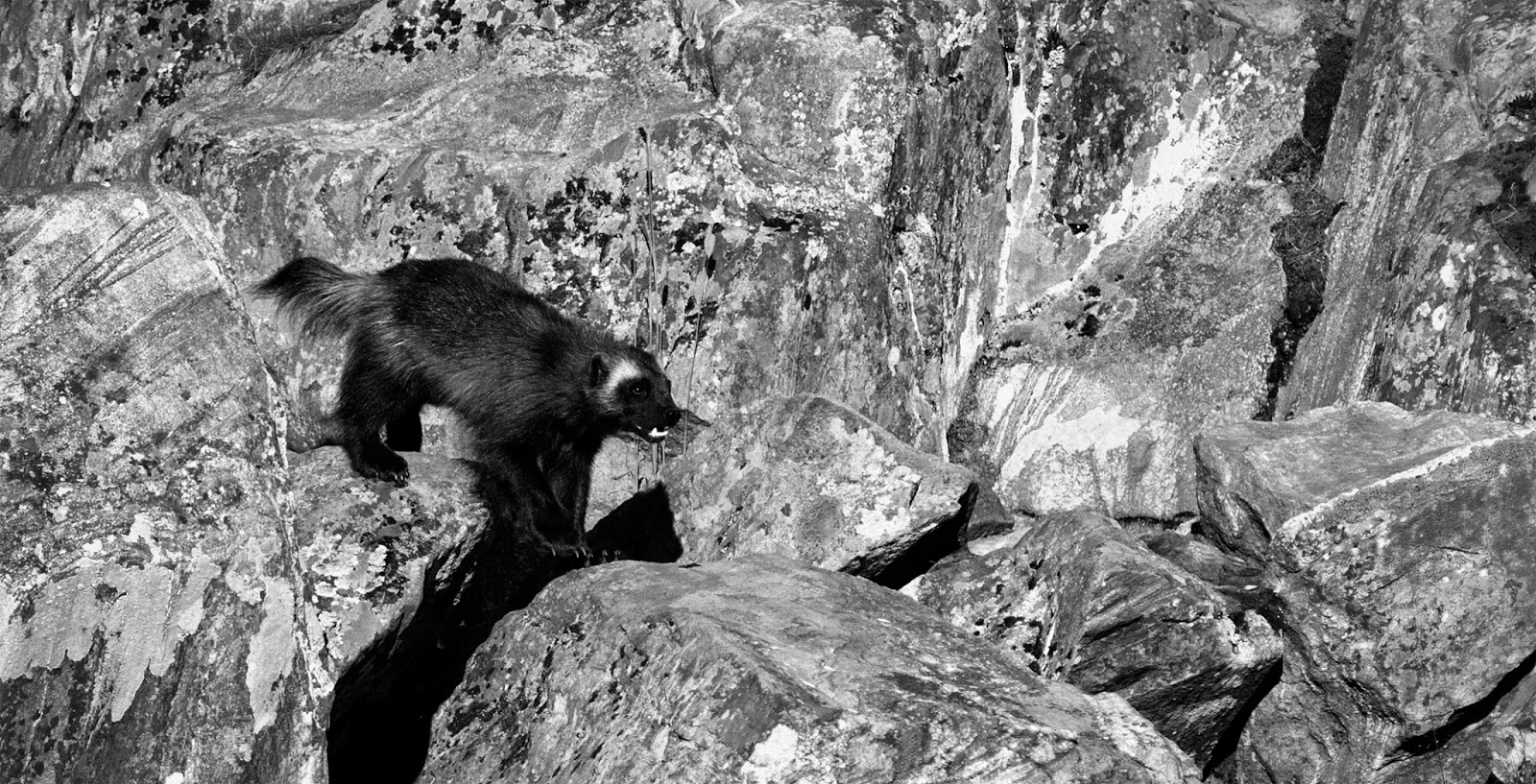
Amongst the interesting behaviour characteristics that are shown during the mating period, there has also been a very healthy local activity of Wolverine. There are currently three individuals which have been frequenting the surrounding area. A few of the nights while I was fishing, I was fortunate enough to witness the three individuals moving along the bank of the lake together. The group is likely to consist of two parents and one adult cub, due to Wolverine being particularly territorial, and they would simply not allow another individual in such close proximity. Whilst photographing in the hides it has been possible to get some great images of these fascinating predators. While in North America, these animals are becoming harder and harder to see in the wild, Scandinavia is fortunate enough to have small populations of Wolverine dotted about, and when in the right location at the right time, some amazing encounters can take place!
 |
| On the move |
In between focusing on the larger male bears, you can also be fortunate enough to witness some yearling cubs move through the area. These cub were born last January and are now 18 months hold. They are extremely nervous and tentative, especially at this time in the year due to the aggressive male bears. They can offer you some unique images due to this behaviour, such as the image below. This cub was on the lookout for any movement across the wetland, every few meters it would rise up on its hind legs to get a clearer view across the expanse. Male bears possess a high risk situation for these cubs, If their mother is with them and a male wishes to mate, it is possible that the male bear will try and chase off, and in the worst cases kill the cubs, to naturally kick start the females hormonal cycle, so that he will be able to mate with her in a few days.
 |
| On the lookout |
1 Jun 2014
Remote camera mission
Over the past few weeks I have been trying to perfect my 'remote camera' work. I have been using my older 40D body, along with an inexpensive EF-S lens, to try and capture an up close and personal view of the Brown Bears. After two failed attempts due to snowy conditions, frozen equipment and obviously, dealing with wild animals, I was finally able to achieve - to some extent - what I set out to capture.
 |
| Third time lucky |
The above image was taken at approximately 22:00. I used the TV (shutter speed priority) function on my body, to ensure that the shutter speed was sufficient enough to hold the detail sharp, even with the movement of the animal (1/100 sec). Due to my 40D using a prehistoric image processor, 'low light capability' is something of a dream. I manually set the camera up for ISO 1250, which after testing seemed the highest I could get away with, before destroying ALL of the detail in the RAW files. Due to using TV mode, the aperture was left to fluctuate along with the available light, this was necessary as the Bears can come at any time, along with any amount of light. My best case scenario was that a Brown Bear would arrive in 'good' light, so that the camera would have to 'stop down' to achieve the correct exposure. As I had manually focused to a distance I felt was likely, by the camera stopping down - due to a good level of ambient lighting - the plane of focus would be deeper, and thus, more likely to keep the animal in focus.
 |
| Big foot |
One morning after spending a night in the forest hide, I decided to take a quick walk deeper into the forest to search for some nice tracks on the fresh snow. I found a large collection of tracks from; Bear cubs, Wolverine and adult Bears ranging in different sizes, one trail of prints in particular caught my eye. This was likely to be Brutus' hind paw track, just by looking at the shear size of the print. I can now fully understand the legend of the Bigfoot if you were to see these tracks in the middle of the wilderness, and even slightly resembling a human track. In terms of size, my boots are UK 12 / EUR 47, so you get some idea of the mass of this animal.
 |
| Frozen in time |
 |
| Brutus please, it is not a toy |
28 May 2014
Wild Brown Bear Centre - www.wbb.fi
Late last night, after two months of design and preparation, I added the final touches to the new Wild Brown Bear Centre website.
It is now a complete directory of information, regarding the services offered by the Wild Brown Bear Centre | Kuhmo | Finland. Useful pages include 'Info' & 'Hides', where it is possible to cycle through the available photography hides, in order to select a vantage point, that will maximise your chances of capturing the perfect image.

22 May 2014
Summer is coming
When the hides become hotter than the sauna

Recently the temperature here has been through the roof, much like elsewhere in Europe. What makes it slightly more amazing is that one week ago today, it was -2 Degrees, and there was 10cm of snow on the ground. The high temperatures have brought about another leap of life to the landscape, although Spring was already establishing itself at the end of April, it is now well and truly here. The leaves on the aspen and birch have already opened and the vista has turned a rich green in colour. This spout of life is also reflected down nearer the bear hides, where the grasses populating the pond are beginning to saturate.


Gretel Langenscheidt
A truly inspirational character

Last week I transferred Gretel Langenscheidt back towards Kajaani Airport. I listened intently to her stories, whether it was; tracking wild Panda's deep inside China, photographing the Spirit Bear along Canada's pacific coast, or the relatively tame trip to Wild Brown Centre last Autumn. Although the fear of the forest beast has slightly relaxed on me, hearing first person travel stories, has, and will continue to thrill me, throughout my stay here.
What Gretel has seen is more than many will, in their lifetime, and to just add a cherry on the top, the above (only the tip of the iceberg) has occurred since becoming, what society labels an 'OAP'.
She was not only more physically able than many of the guests here, but also, by far the most positive and forward thinking individual I have met so far - during this adventure and before. It was a pleasure on her last morning to take her portrait, shown above, and I know for certain that she had a wonderful trip here.
Birds and Hoes

Two pairs of Goldeneye have been frequenting the small pond in the hide area for last 2 weeks. They are currently focused upon their mating rituals, which you can see the male acting out in the photo above. In between they dive below the surface to search for aquatic saplings. I spent about 30 minutes solidly trying to capture this 'diving' moment, to no avail, so I made a few nice images of the individuals in the water. Where they get their name from is quite self-explanatory, although the females tend to have a slightly less saturated colouring in the eye.

 The photo to the left is a very nice example of an adult male Goldeneye. He has a beautifully defined contrast between his upper and lower body, with the brightly coloured 'Golden' 'Eye' adding colour to either side of the head. An intruder male visited the ponds several times whilst this male was courting his female (Right and Above), the two broke into a fierce battle, both, submerged and on the surface of the pond. Finally ending with the intruder being chased away, fleeing from the pond.
In between photographing the large apex predators, you take time to see what other auxillary wildlife is around. This small Wood Sandpiper spent an hour circling the perimeter of the pond, just teetering on the edge, searching for dinner. Fortunately enough it came within 2/3m of my hide and I was able to snap a few photos of it.
There has also been a pair of loudly displaying Greenshank, which have been present at the side of the pond on most nights. They too offer a welcome change of subject whilst photographing the larger mammals for the duration of the night.

18 May 2014
We named him 'Brutus' the Brown Bear
One quick glance puts you right back in your place

During May, the male Brown Bears have only one thing on their mind, females. Fortunately for myself and the photographers, so far they have also been extremely photogenic, coming in beautiful evening light and sometimes staying right up until sunrise. Since the start of May the bears have been plentiful, with several males regularly frequenting the area. I have seen approx. 7/8 different individuals - including the two cubs - in the area, which is a remarkable improvement on last season, where the number of bears in the local area was maybe half of what it has been presently.
This post is dedicated to one bear in particular, he has earned the title of 'Brutus', primarily for being very large and bearing the meanest of stares. He has been by far the largest male in the area since the start of May, with several characteristics making him easily identifiable. Firstly, his size in comparison to the females he pursues. Secondly, his 'grizzly' appearance, his head, neck and shoulders are very light in colour, coupled with the darkened roots, his colouring is particularly unique when compared to the other individuals. Lastly, his darkened lower eye sockets. When juxtaposed against his lighter fur - even at 200m - these markings are easily distinguishable.
The true size and strength can only be felt in the forest
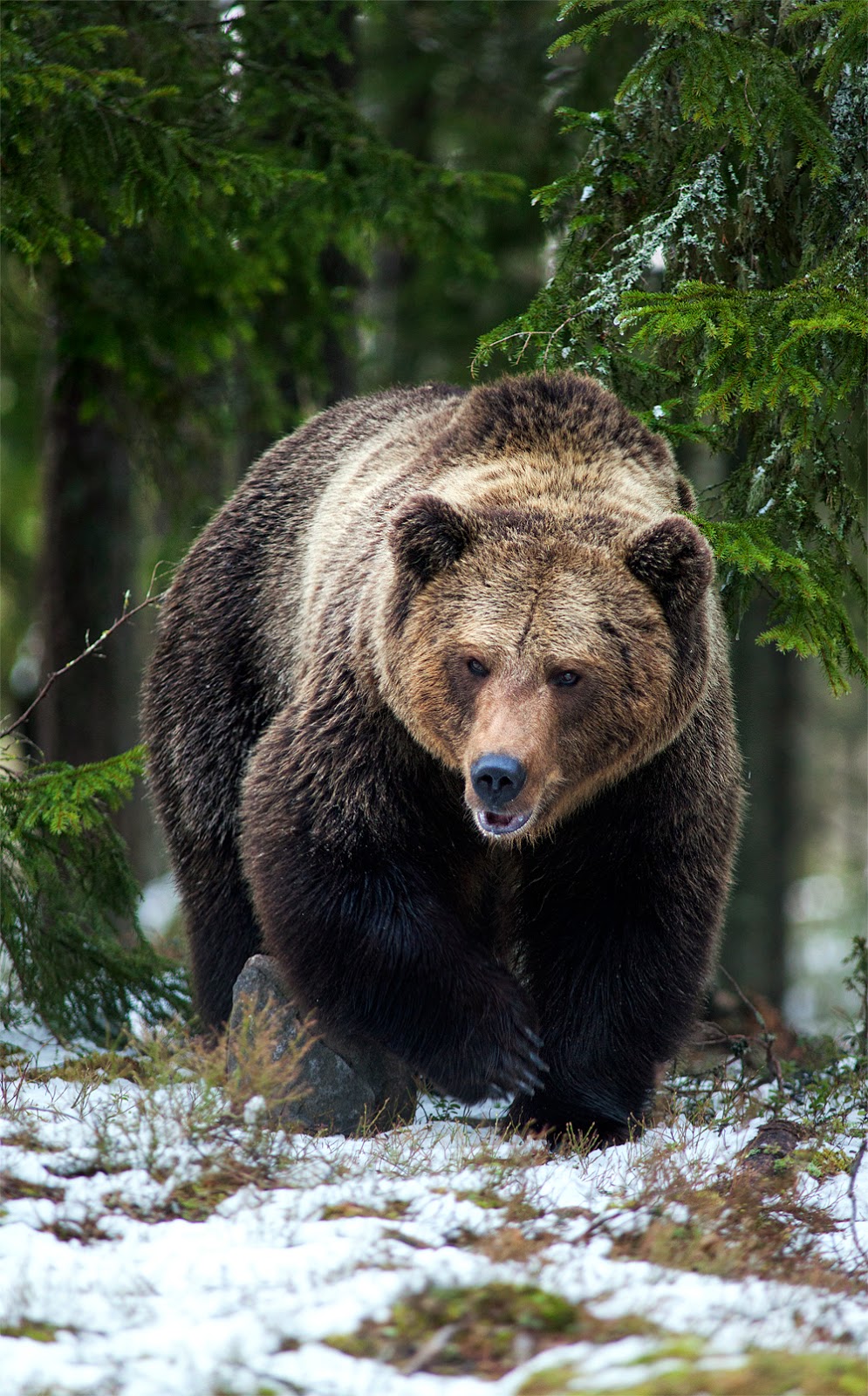

After spending three exciting nights in the hides, I have made a large collection of images which need to sorted, edited and presented. I will shortly post 'nightly reports' on each of the three nights spent in the hides, due to the large volume of material which has amounted. Brutus was present on all three nights, particularly on the last night, where he gave a wonderful display of mating and dominant behaviour in the most beautiful light.
After spending more and more time in front of these incredible mammals, you start to develop a deeper understanding of their specific characteristics and behaviour, and dare I say it, personalities. Brutus is a very confident individual, which is expressed in his slow and lethargic movements. Due to the dominance he holds in the area, he spends more time demonstrating natural and relaxed behaviour (shown above), when compared to some of the younger males. The younger or smaller males typically spend most of their time alert, and on constant watch with their eyes and nose.
After spending more and more time in front of these incredible mammals, you start to develop a deeper understanding of their specific characteristics and behaviour, and dare I say it, personalities. Brutus is a very confident individual, which is expressed in his slow and lethargic movements. Due to the dominance he holds in the area, he spends more time demonstrating natural and relaxed behaviour (shown above), when compared to some of the younger males. The younger or smaller males typically spend most of their time alert, and on constant watch with their eyes and nose.
Evening reflection of an incredible machine

14 May 2014
White Wednesday
Wild Brown Bear Centre Finland | Kuhmo | Finland

We woke this morning to a white landscape, even through the eyes of Karhu, it was a beautiful sight. It had started falling at 5am and had already accumulated 10 centimetres in some places. The trees are heavily covered, and their branches are bending towards the ground. I took a loner Sigma 35mm F1.4 out before breakfast, capturing the change in scenery around the lodge. The heavy snow fall had created a small winter wonderland around the Centre, and it was nice to compose some different and unique images on my front doorstep. A scene that will probably be absent for the remainder of my stay here.

On Monday morning, Sam and I drove out of Vartius and headed northwards in search for some landscapes, after an exhilarating night in the hides. After an hour we found a dirt track leading to Hepoköngäs, one of Finland's largest waterfalls. After a short walk through thick pine forest, we came to the top of the falls. The main section had a steep 20m drop, with smaller cascades surrounding it. The area was extremely photogenic, with snow still deep in the surrounding forest, and ice formations framing the waterfall.
On our walk back to the car, we spotted some fresh wolf tracks on the snow, It was a nice indication that the area holds a healthy population of Canis Lupis, and a good addition to the sightings that myself and visitors have had over the last month. I will definitely return to this waterfall over summer and in the Autumn when the colours will be amazing, perhaps even with some guests as part of a workshop.

11 May 2014
The coast is clear
Wild Brown Bear Centre | Kuhmo | Finland

Last evening I thought it was about time I endured another sleepless night, in the quest for the perfect bruin. The weather in the north has finally shifted towards Spring, the days are getting longer, the nights are no longer dark. The rising temperatures show that winters grip will finally be released in the coming weeks. The various lakes around the Centre have begun to thaw, revealing dark, black water, that hasn't seen the light of day since November.
This change has sparked a leap in activity at the hides, with various species of waders and ducks visiting frequently during the evening. Two pairs of Goldeneye where swimming the perimeter of the pond, tirelessly searching for food deep beneath the water. After a day of cloudy, desaturated light, the sky opened up and revealed the brilliance of the Spring sun. The sunset pictured above was one of the nicest since I have been here, the pink clouds seemed to dance across the sky in a stiff breeze, just as the sun was dipping out of sight.
The coast is clear

In a sudden rush, two, year-old cubs darted from the edge of the forest. Their cautious mother bounded after them, vocally warning them not to move any further out onto the wetland. After calling them back towards her, she slowly moved forward, tasting the air and scanning the area for dangers. As the wind was blowing towards the hides, our scent took longer to reach her and the cubs, but after about 20 seconds she got wind and moved quickly across the open ground, calling for her cubs to follow.

Whilst scanning for the large predators I took photographs of some of the bird life. This Wagtail seemed extremely intrigued with its reflection in the water, seeing itself for the first time after the winter perhaps. With such a great abundance of wildlife in the area, an evening spent in the hides is frantic and filled with excitement. With a lone ranger inbound, I will be spending many more nights in the hides in the coming week, and hope to catch up with the cubs and their mother.
4 May 2014
Moonscape
Moonrise - 15th April, ~ 23:00 pm, -5 Degrees Celsius

Although this image may appear more like a sunrise at 5:00 am, It is in fact a full moonrise at 23:00 pm. The fury critters had turned in for the night, and I slipped into the 24-105 for some ball-head mounted landscapes. I had the shutter set to about 2 and half minutes, F4/F5.6 and a reasonable ISO to minimize all distracting noise. I am always pleased with long exposures if they turn out correctly, as it's definitely not an exact science. It was nice to see the scenery under a completely unique light for the first time as well. Pictured is 'Hide 1', the first photo specific hide which was built almost 15 years ago.

I challenge anyone to find a more tranquil start to your day than waking to this scene. The echoing noise of a pecking woodpecker, skimming across the frozen ground, and the rising sun soaking the trees in a rich, golden light. Nothing is more peaceful.
3 May 2014
Black & White but still Brown

I am very pleased with how April panned out. Ari told me that I have been extremely lucky with the depth and diversity that has presented itself throughout the month. For me, I am also really pleased with the range, and dare I say, quality of some of the images I have been able to produce, and I feel equally, 'document' during the entirety of April.
The photo above was taken on the 16th April during the evening, the snow cover was still thick, and the night was extremely fresh, cold and clear. It was also the night of the blood full moon, but I shall touch again on this night by exhibiting some landscapes later on. The bear photographed is my favourite bear so far, I feel as though I am slightly bias due to the fact this was my first ever European Brown Bear, but nonetheless this male is an incredible specimen of power and size. He is easily recognisable by his very dark fur and evident scar - dead centre - between his ears.
As a result I chose B&W to document this moment, as he was wading through the thick snow towards me. For his dark fur contrasted against the white sky and ground make for a nice image. The composition was also aided by having two dark ravens perched in the background, but they can take all the credit for being there.

One of my favourite times of the day is breakfast, partly due to being able to feast on continental treats, but also because the photographers return from the hides, and we are always interested in what they have seen, and witnessed throughout the night. One specific night a Hungarian couple were staying for two brief nights en route back from a trip further north. After their second and final night in the hide, I met them at breakfast and engaged in the usual questions about the night before. It turned out that they, and the other guests at the time, had witnessed the first Grey Wolf in the area since October, and although it had been an extremely brief encounter, it had occurred near, and in good light.
It is hardest at these times not to let jealously creep into the equation, although in hindsight I had an even more incredible night on the way. A night that kept me awake throughout, and in a buzz of excitement.
It is hardest at these times not to let jealously creep into the equation, although in hindsight I had an even more incredible night on the way. A night that kept me awake throughout, and in a buzz of excitement.
2 May 2014
White nostalgia

Although a few snow showers have occurred in the recent weeks, the amplitude of these have been far from when I arrived in April. With some more time recently, I have been looking back at some of my photos from when I first arrived. I will share a few more edits here. A tribute of sorts as the snow won't be back for almost 8 months.

There are three different male bears shown here, the one above is a younger male, he moved very quickly and cautiously around the area, constantly moving his eyes around the landscape searching for danger. He was being bothered by the hooded crows at every step and his irritation of that was clearly evident in his movements and behaviour.

My sleeping bear photo above was taken on my very first evening in the hides. This very large male was first out from hibernation and clearly the dominant individual in the area. On several occasions, including this night, he slept in the area. A sign that he was comfortable with dealing with any dangers posed by other predators in the area.
